From Kotler to Code
Marketing’s Journey from Structured Thinking of Kotler to Intelligent Growth Systems
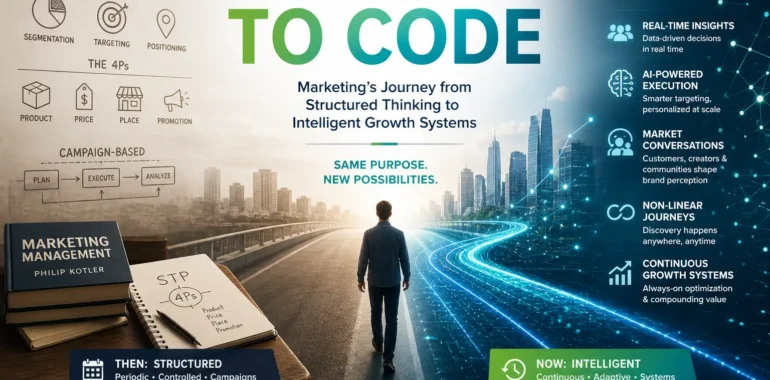
Marketing, as a discipline, has not been disrupted—it has been expanded, accelerated, and rewired. The foundations laid by Philip Kotler still underpin how we think about markets, customers, and value. But the environment in which those principles operate has fundamentally changed.
What was once a structured, periodic function has now become a continuous, intelligent system embedded across the entire business.
The Enduring Core: Why Kotler Still Matters
At its heart, marketing has always been about understanding human needs and delivering value. Kotler’s frameworks—Segmentation, Targeting, Positioning (STP), and the 4Ps—were designed to bring structure to that process. They helped organizations move from intuition-led selling to systematic market understanding.
Even today, no serious marketing effort begins without answering three essential questions:
- Who are we serving?
- What problem are we solving?
- Why should they choose us?
These are fundamentally Kotler’s questions.
However, while the questions remain the same, the methods of answering them have evolved dramatically.
From Static Segments to Living Customer Signals
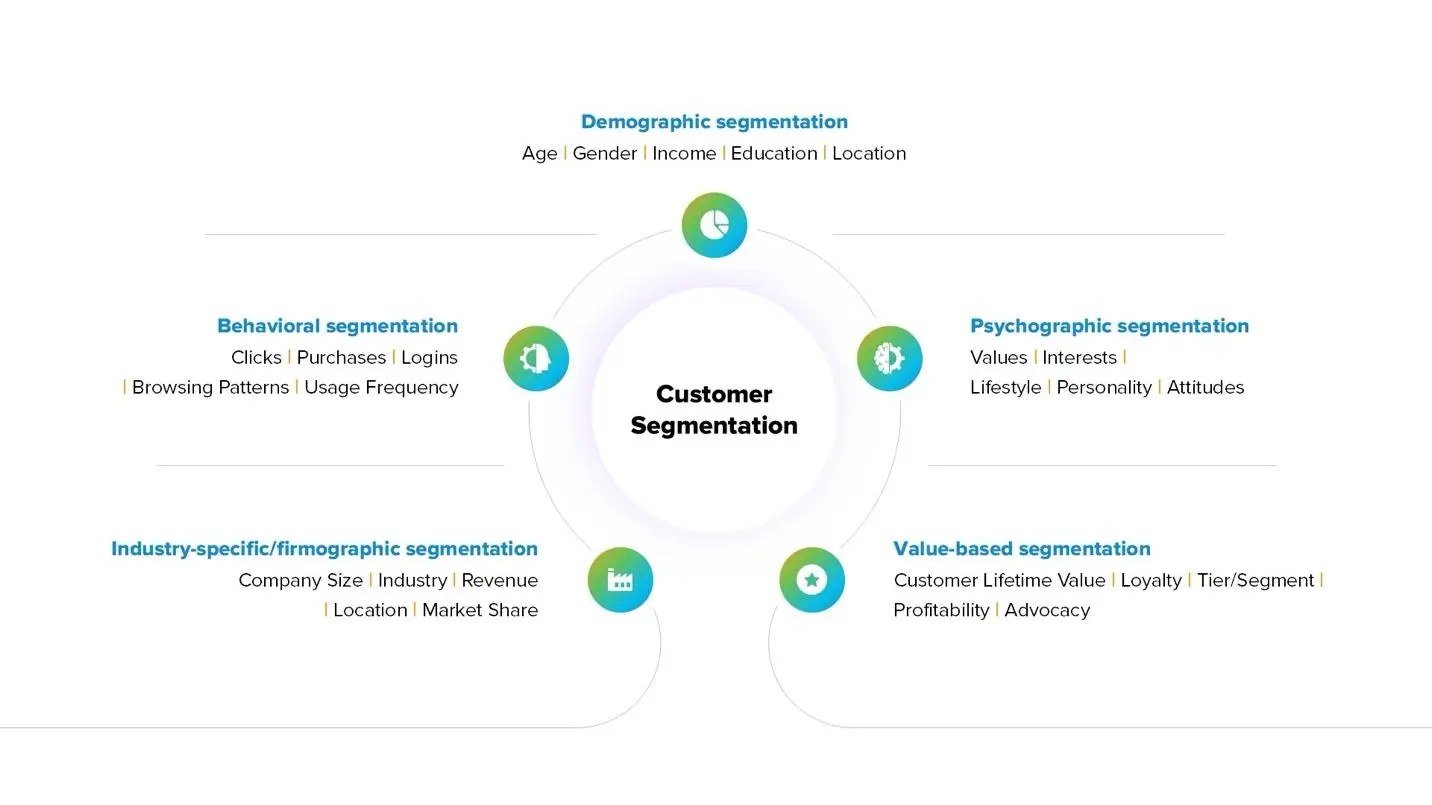
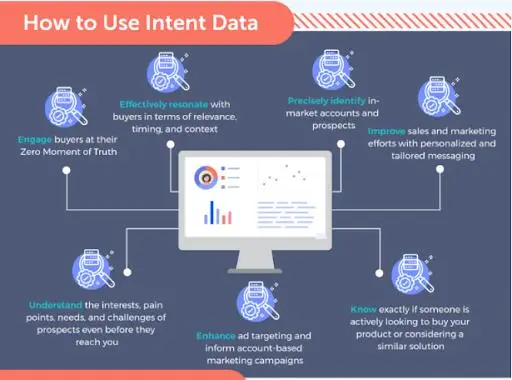
In Kotler’s era, segmentation was largely static. Marketers grouped customers by industry, geography, or demographics, and campaigns were designed accordingly. Today, segmentation is no longer a one-time exercise—it is a living, breathing system powered by real-time data.
Modern marketing doesn’t just ask who the customer is; it asks:
- What are they searching for right now?
- What content are they consuming?
- What problems are they actively trying to solve?
This shift has enabled companies like Amazon to move beyond broad targeting into behavior-driven personalization, where every interaction adapts to the user’s intent.
Segmentation has evolved from categories to signals.
The Transformation of the Marketing Mix
Kotler’s 4Ps—Product, Price, Place, Promotion—were once clear levers marketers could control. Today, each of these has expanded into something far more dynamic.
The product is no longer just a set of features; it is an experience, often evaluated before purchase through demos, trials, and peer reviews. Pricing has shifted from static models to value-based narratives, especially in SaaS, where customers expect measurable ROI. Place is no longer physical distribution—it is omnichannel presence, spanning websites, marketplaces, communities, and even AI-driven interfaces.
Promotion has undergone the most dramatic transformation. It is no longer about campaigns that begin and end. Instead, it is an always-on content and engagement ecosystem, where brands continuously educate, engage, and influence their audience.
Companies like HubSpot exemplify this shift. Their growth is not driven by campaigns alone but by a content engine—blogs, tools, courses, and resources—that attracts and nurtures users long before a sales conversation begins.
From Campaign Thinking to Continuous Systems
One of the most profound changes in marketing is the shift from campaigns to systems. Traditionally, marketing operated in cycles: plan, execute, analyze, repeat. Today, it operates as a continuous loop of experimentation and optimization.
This transformation is driven by data and technology. Platforms now allow marketers to test variations in real time, optimize messaging dynamically, and adjust targeting instantly. The result is a system that is constantly learning and improving.
Netflix is a powerful example. It doesn’t just market content—it continuously refines how content is presented, recommended, and even created based on user behavior. Marketing, in this context, becomes inseparable from the product itself.
The Rise of AI and Intelligent Decision-Making
Kotler’s frameworks assumed that marketers would design and execute strategies. Today, much of that execution is increasingly handled by AI-driven systems.
Platforms like Meta now use machine learning to optimize campaigns automatically—selecting audiences, adjusting bids, and even generating creative variations. The marketer’s role is shifting from execution to orchestration and strategy.
This doesn’t replace Kotler’s thinking—it amplifies it. The principles guide what to do; AI determines how best to do it at scale.
From Brand Control to Market Conversations
In the past, brands controlled their narratives through advertising and messaging. Today, perception is shaped by customers, communities, and creators. Reviews, social media conversations, and peer recommendations carry more weight than traditional campaigns.
Consider Tesla. Its brand has been built with minimal traditional advertising, relying instead on community advocacy, customer enthusiasm, and leadership visibility. This reflects a broader shift: trust is no longer broadcast—it is earned and shared.
The Death of the Linear Funnel
Kotler’s funnel—awareness to purchase—was a useful abstraction. But today’s customer journeys are anything but linear. A buyer might discover a product through a YouTube video, validate it through reviews, compare it on a marketplace, and finally convert after interacting with multiple touchpoints.
Companies like Spotify thrive in this environment by creating continuous engagement loops, where discovery, usage, and advocacy reinforce each other.
Marketing is no longer about pushing customers down a funnel—it is about designing an ecosystem where they move fluidly.
The Synthesis: Structure Meets Intelligence
The evolution of marketing is not about replacing Kotler—it is about building on him. His frameworks provide the structure and clarity needed to understand markets. Modern tools and methods provide the speed, precision, and scalability required to operate in today’s environment.
If Kotler gave us the map, modern marketing gives us real-time navigation.
What This Means for Marketers Today
To succeed in this new landscape, marketers must operate at two levels simultaneously.
They must retain the discipline of structured thinking—understanding customers, defining value, and positioning clearly. At the same time, they must embrace a new mindset: one that is data-driven, experimental, and deeply integrated with technology.
The most effective marketers today are not those who abandon traditional principles, but those who translate them into modern systems.
Closing Thought
Marketing has always been about people. That hasn’t changed. What has changed is our ability to understand them, reach them, and serve them at scale.
The future of marketing belongs to those who can combine –
Kotler’s strategic depth with the agility of modern, intelligent systems.
Here is a Free Download of this article – Kotler to Code as a PowerPoint and a few models created by experts in the industry. Click the image below to download.